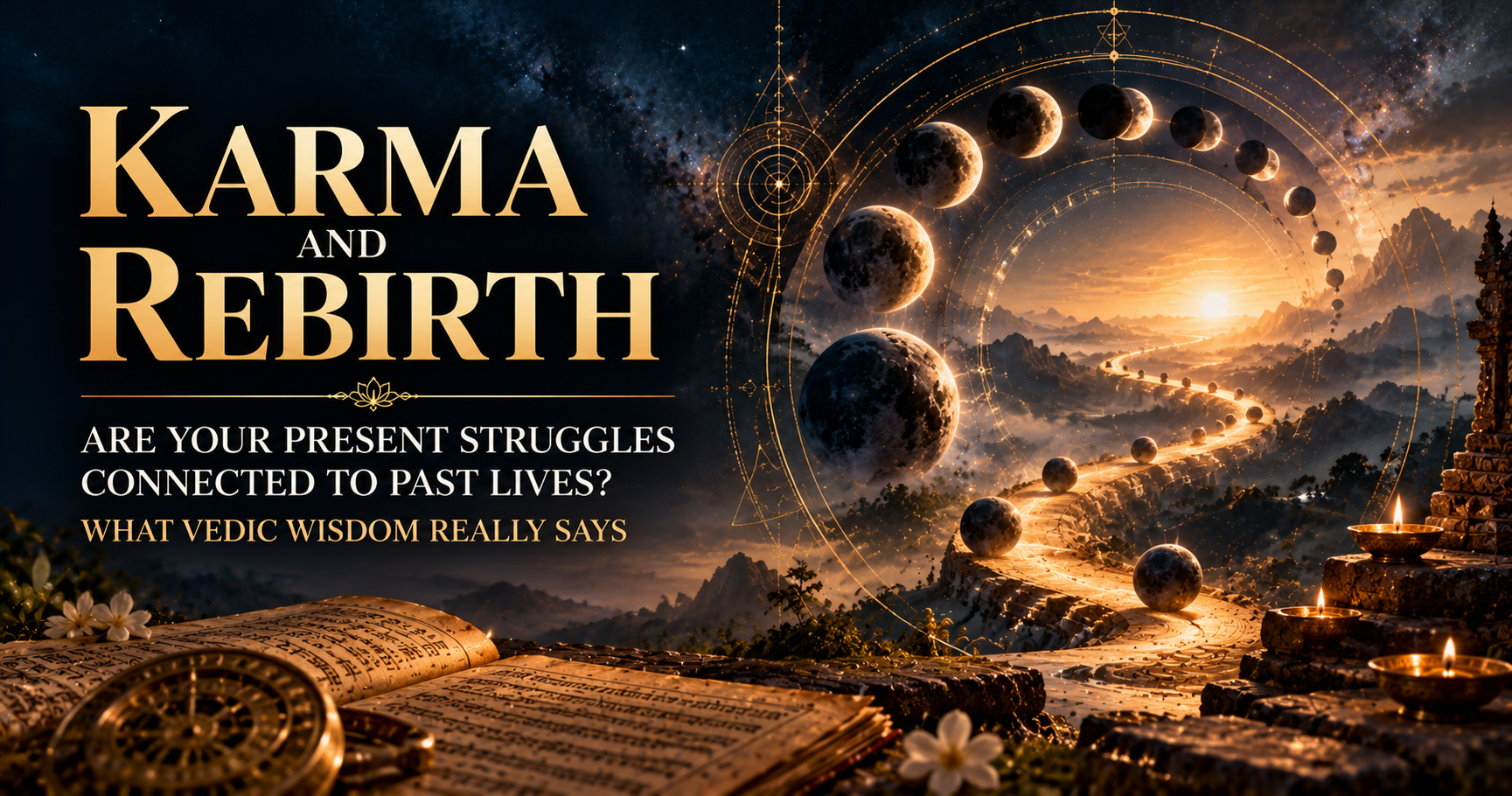
Karma and Rebirth: Are Your Present Struggles Connected to Past Lives? What Vedic Wisdom Really Says
Two people work equally hard. One appears to succeed effortlessly, while the other faces repeated setbacks. One is born into comfort; another must struggle for basic security. Why does life seem so unequal?
When people encounter these differences, they often turn to an ancient question: Could our present circumstances be connected to actions from previous lives?
In Indian philosophical traditions, the concepts of Karma and Rebirth offer one way of exploring this question. But these teachings are more complex than the popular idea that every good or bad event is a reward or punishment from the past.
Understanding them requires more than accepting comforting explanations. It requires examining what the tradition teaches, what remains uncertain, and what responsibility we have for the choices we make today.
1. What Does Karma Really Mean?
The Sanskrit word karma broadly means action or deed. In many Indian philosophical and religious traditions, actions are also understood in relation to intention, consequences, ethical responsibility, and future experience.
The principle is often summarized as: actions have consequences.
But this should not be reduced to the simplistic belief that every person who suffers must have done something wrong or that every successful person must be morally deserving.
Real life is influenced by numerous factors, including family circumstances, social structures, health, opportunity, natural events, and the decisions of other people.
The concept of karma belongs to a broader philosophical framework. It should not become a convenient explanation for every event we cannot understand.
A more useful question is this: Given the circumstances I face, what choices can I make responsibly now?
2. Does Vedic Philosophy Teach Rebirth?
Rebirth, often discussed through the concept of samsara, is an important teaching in several Indian traditions, including Hindu philosophical schools.
Within many of these traditions, the cycle of birth, death, and rebirth is connected to karma. Actions and their consequences are understood as part of a larger process extending beyond a single lifetime.
The Bhagavad Gita, for example, discusses the enduring nature of the self and uses the changing of bodies as an analogy to explain the transition associated with death and rebirth.
The Upanishads also explore the relationship between action, knowledge, the self, and continued existence.
However, Indian philosophy is not a single, uniform system. Different schools interpret the self, karma, liberation, and rebirth in different ways.
These are significant philosophical and spiritual teachings, but rebirth has not been established as a scientifically verified explanation for an individual's present circumstances.
Studying the tradition does not require pretending that every question has been settled.
3. Three Traditional Concepts of Karma
Some Hindu traditions distinguish between different forms of karma to explain how actions and consequences are understood over time.
Sanchita Karma: The Accumulated Actions
Sanchita Karma is traditionally described as the accumulated store of karma from past actions across lifetimes.
Within this framework, it represents a broader accumulation rather than only the consequences currently being experienced.
This is a traditional metaphysical concept, not a measurable record of past-life actions that can be independently verified.
Prarabdha Karma: The Karma Being Experienced
Prarabdha Karma is commonly described as the portion of accumulated karma associated with the present life.
Some interpretations use it to explain circumstances that are already unfolding or that appear beyond immediate personal control.
But this concept must be approached carefully. It does not establish that a person's illness, financial hardship, family difficulties, or personal loss is punishment for something they did in a previous life.
Claiming to know the hidden karmic cause of another person's suffering goes beyond what can be reliably established.
Kriyamana Karma: Actions Being Created Now
Kriyamana Karma, sometimes discussed alongside the related term Agami, concerns actions being performed in the present and their future implications.
Terminology and classifications vary across traditions, but the practical insight is important: what we do today matters.
Your decisions, habits, relationships, professional conduct, and treatment of others can influence future circumstances.
You cannot control everything that happens to you. You can, however, examine how you respond and what you choose to do next.
4. Are Your Present Struggles Punishment for a Past Life?
This is where the discussion becomes especially sensitive.
Someone facing financial hardship may wonder whether they are paying for past-life mistakes. A person experiencing relationship problems may be told that their suffering is karmic. Someone dealing with illness or loss may be encouraged to accept their circumstances as predetermined.
Such explanations can create guilt, helplessness, or fear.
There is no reliable method for establishing that a particular person's present suffering was caused by a specific action in a previous life.
Even within a tradition that accepts karma and rebirth, claiming certainty about an individual's unseen karmic history is a much stronger claim than discussing the general philosophical doctrine.
Suffering should not automatically be interpreted as evidence of wrongdoing. Nor should people be discouraged from seeking medical care, legal protection, financial guidance, or practical support because someone has labelled their situation karmic.
Compassion requires acknowledging suffering without inventing a reason for it.
5. Karma Versus Destiny: Are Your Choices Still Important?
One of the most useful questions in this discussion is whether destiny determines everything.
Indian philosophical traditions have explored the relationship between past actions, present circumstances, individual effort, and freedom in different ways. There is no single interpretation shared by every school.
In practical life, however, confusing circumstances with destiny can be dangerous.
Imagine someone whose business is failing. They might conclude that their karma has predetermined the outcome and stop trying to understand the problem.
A more constructive response would be to examine cash flow, customer needs, pricing, operational weaknesses, and available alternatives.
Or imagine someone trapped in a harmful relationship who is told that the relationship is a karmic obligation. Such a claim should never be used to pressure them into accepting abuse.
A belief in karma need not mean surrendering your judgment.
You can acknowledge circumstances beyond your control while still taking responsibility for the decisions available to you.
6. How to Apply the Wisdom of Karma Today
Rather than using karma to explain every event, consider applying its ethical dimension to everyday life.
Examine your intentions. Before acting, consider whether your choices reflect honesty, responsibility, and respect for others.
Accept consequences. When you make a mistake, acknowledge it, learn from it, and repair the harm where possible.
Avoid judging others. You do not know another person's complete circumstances, history, or inner struggles. Do not assume that their suffering is deserved.
Act without demanding complete control. You can make thoughtful decisions without expecting every effort to produce an immediate or predictable result.
Focus on what is possible now. You may not be able to change the past, but you can reconsider a habit, seek help, improve a skill, or make a more informed decision today.
These practices do not require proof of rebirth. They offer practical ways to reflect on action, responsibility, and ethical living.
Conclusion: Your Past Is a Question, Not a Verdict
Karma and rebirth remain important concepts in Indian spiritual and philosophical traditions. Sanchita, Prarabdha, and Kriyamana Karma offer different traditional ways of discussing accumulated actions, present circumstances, and current choices.
But these concepts should not be used to claim certainty about why an individual suffers, what happened in a previous life, or what must happen in the future.
You do not need to label every difficulty as punishment to learn from it. You do not need to assume that success is guaranteed to act responsibly. And you do not need to know every hidden cause of life to make a wiser decision today.
Perhaps the most meaningful question is not, “What did I do in a past life to deserve this?”
It is: “Given the life I have today, what kind of person will my actions help me become?”
Explore Vedic Wisdom with VEDAUM
Register at www.vedaum.life to explore Vedic knowledge, philosophical traditions, and deeper questions about karma, self-understanding, and conscious living.
VEDAUM's principle: Where something can be measured, its limitations must also be stated. Where an outcome cannot be reliably established, it must honestly remain uncertain.