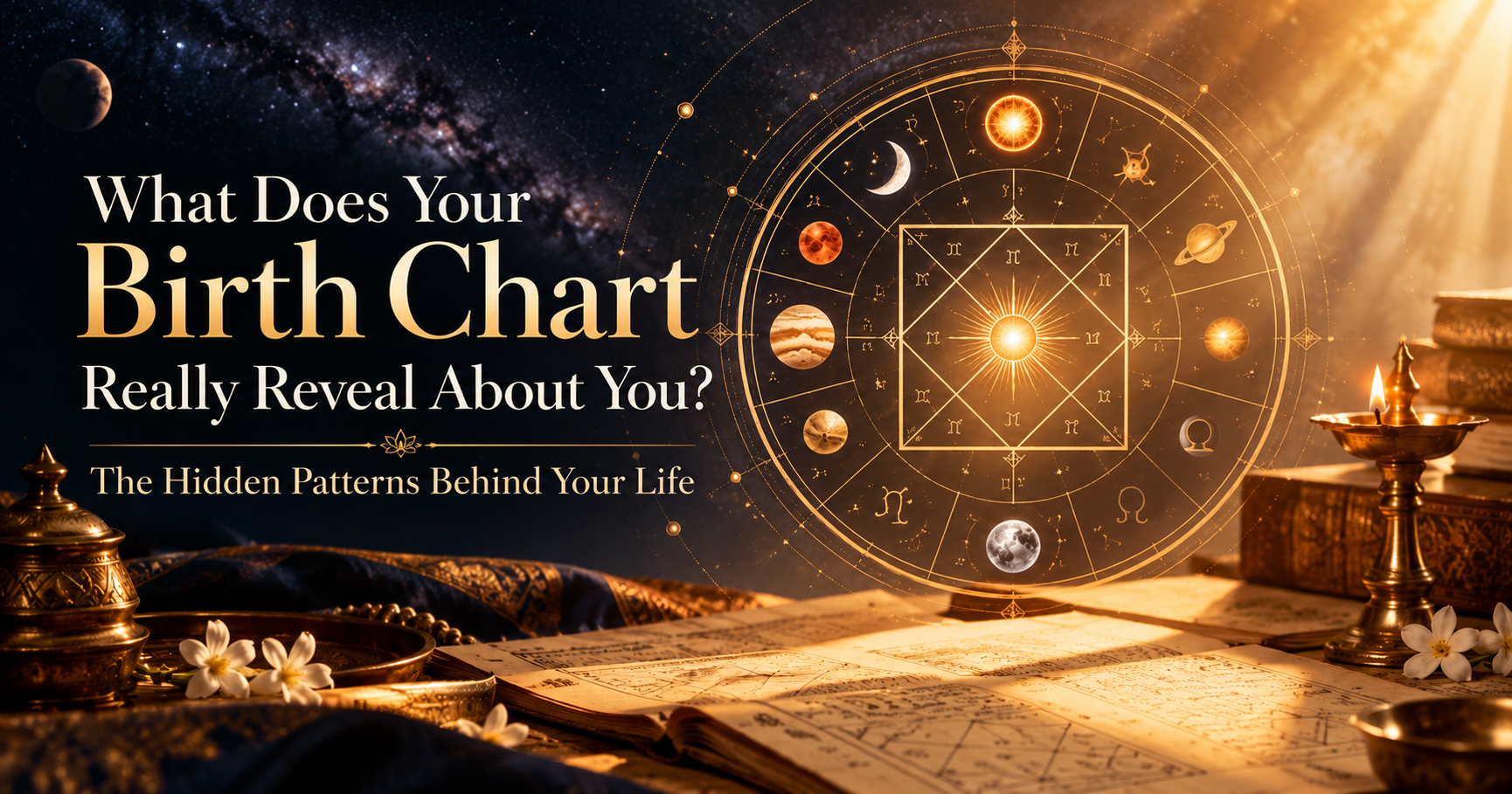
What Does Your Birth Chart Really Reveal About You? The Hidden Patterns Behind Your Life
You make decisions every day. Some move you closer to the life you want. Others keep you trapped in the same patterns, repeating the same mistakes with different people, different circumstances, and different excuses.
Why do some people remain calm under pressure while others become overwhelmed? Why do certain relationship patterns repeat? Why do some phases of life seem to demand patience while others invite action?
Vedic astrology offers an ancient framework for exploring these questions: the Janam Kundli, or Vedic birth chart.
But there is a crucial distinction between using astrology to understand yourself and using it to surrender responsibility for your life.
Your birth chart should not become a prison of predictions. It should become a starting point for self examination.
1. What Is a Vedic Birth Chart?
A Vedic birth chart is a symbolic representation of the positions of celestial bodies at the time and place of your birth, interpreted through the traditional system of Jyotisha.
It is calculated using your birth date, birth time, and birthplace.
The chart includes the twelve houses, zodiac signs, planetary placements, and the Ascendant, known in Sanskrit as the Lagna. Astrologers interpret these elements together to explore different areas of life, including personality, relationships, career, responsibilities, and spiritual development.
Think of the birth chart as a traditional interpretive framework, not a scientifically validated personality test or a guaranteed forecast of your future.
Its greatest practical value lies in the questions it encourages you to ask about your own behaviour.
2. Your Lagna: The Way You Approach Life
In Vedic astrology, the Lagna, or Ascendant, is the zodiac sign rising on the eastern horizon at your birth.
It establishes the structure of the birth chart and is traditionally associated with your physical orientation toward life, temperament, and approach to circumstances.
For example, Vedic astrology traditionally associates Aries Lagna with initiative, Taurus Lagna with stability, Gemini Lagna with curiosity, and Capricorn Lagna with discipline and structure.
These are traditional interpretations, not proven descriptions of every individual born under these signs.
The more useful question is this: How do you respond when life becomes difficult?
Do you act immediately? Do you seek certainty before moving? Do you analyse every possibility? Or do you withdraw until the pressure passes?
Your observable behaviour tells you more about your actual tendencies than a label alone.
Use your Lagna as an invitation to investigate your behaviour, not as an excuse to defend it.
3. Your Moon Sign: Understanding Your Emotional World
The Moon holds a particularly important place in Vedic astrology. Your Chandra Rashi, or Moon sign, is traditionally associated with your mind, emotional responses, habitual perceptions, and sense of inner security.
Imagine two people receiving the same criticism.
One examines the feedback and improves. The other becomes defensive and spends days thinking about the conversation.
The difference may involve past experiences, emotional habits, personal beliefs, and individual circumstances.
Vedic astrology offers its own symbolic language for exploring these patterns through the Moon sign, its house placement, and its relationship with other planets.
The practical lesson is straightforward: learn to observe your emotional reactions before allowing them to dictate your decisions.
When you understand what repeatedly triggers you, you gain more freedom to choose how you respond.
4. The Twelve Houses: Twelve Areas of Life
The twelve houses of a Vedic birth chart represent different areas of human experience within traditional astrological interpretation.
Here is a simplified overview:
First house: Identity, appearance, and personal orientation.
Second house: Family, accumulated resources, speech, and values.
Third house: Communication, initiative, skills, and courage.
Fourth house: Home, mother, emotional foundations, and domestic life.
Fifth house: Creativity, education, intelligence, and children.
Sixth house: Service, daily challenges, competition, and responsibilities.
Seventh house: Marriage, partnerships, and significant one to one relationships.
Eighth house: Transformation, shared resources, vulnerability, and hidden matters.
Ninth house: Beliefs, higher learning, teachers, and philosophical inquiry.
Tenth house: Career, public responsibilities, and professional standing.
Eleventh house: Gains, networks, aspirations, and communities.
Twelfth house: Expenditure, retreat, seclusion, and spiritual contemplation.
These meanings are broad traditional associations. A complete interpretation considers the Ascendant, house lordships, planetary placements, aspects, and the overall chart rather than isolating one house.
The strategic value of this framework is perspective. Instead of asking only whether you will succeed, you can ask what success means to you, which responsibilities you avoid, how you manage resources, and what kind of relationships support your ambitions.
5. Planetary Placements: Strengths, Challenges, and Contradictions
Vedic astrology interprets the nine Grahas, including the Sun, Moon, Mars, Mercury, Jupiter, Venus, Saturn, Rahu, and Ketu.
Each has a distinct symbolic role.
The Sun is associated with authority, identity, and vitality. The Moon relates to the mind and emotions. Mars represents energy, initiative, and conflict. Mercury is linked with communication and analytical ability. Jupiter signifies wisdom, knowledge, and expansion. Venus relates to relationships, pleasure, and aesthetics. Saturn represents discipline, limitations, responsibility, and endurance. Rahu and Ketu are the lunar nodes, associated in traditional interpretation with desire, disruption, detachment, and spiritual inquiry.
However, no planet should be interpreted in isolation.
A Saturn placement does not automatically mean failure. Mars does not inevitably create conflict. Jupiter does not guarantee wealth.
Interpretation depends on the complete chart and the astrological tradition being followed.
A useful approach is to translate symbolic interpretations into practical questions.
If discipline is a recurring theme, where do you need stronger habits? If desire is a recurring theme, which ambitions deserve your energy? If communication is a recurring theme, are you listening carefully enough before responding?
The point is not to blame the planets. It is to examine the choices within your control.
6. Can Your Birth Chart Predict Your Future?
This is where curiosity often turns into dependency.
People want certainty about marriage, wealth, career advancement, children, and difficult periods. Astrology offers traditional methods for interpreting timing, including Vimshottari Dasha and planetary transits.
These systems can be explored as part of India's astrological heritage. However, their predictions have not been established as scientifically reliable methods for forecasting individual life events.
No responsible interpretation should convince you that your future is fixed, that disaster is inevitable, or that an expensive remedy is necessary to escape a predicted outcome.
Your decisions must still account for evidence, circumstances, preparation, relationships, and consequences.
A birth chart cannot replace financial planning, professional advice, medical care, or honest communication.
The strongest approach combines cultural and spiritual exploration with independent judgment.
7. The Real Power of Knowing Yourself
Consider a simple example.
You repeatedly postpone important decisions because you fear making the wrong choice. You then interpret the delay as bad timing and wait for a more favourable phase.
Months pass. Opportunities disappear. Your confidence weakens.
What changes the situation?
Not another prediction. Not another reason to postpone.
The change begins when you recognise the pattern, understand its causes, set a deadline, evaluate the available evidence, and take responsibility for a decision.
This is where self knowledge becomes useful.
You cannot control every circumstance. You can improve how you prepare, how you respond to uncertainty, and how consistently you act according to your values.
Whether you approach self understanding through Jyotisha, meditation, philosophical inquiry, or reflective practice, the objective should be greater clarity and more conscious action.
Your circumstances may influence your choices, but they do not remove your responsibility for them.
Explore Your Inner World with VEDAUM
Your Vedic birth chart is a beginning, not the final word on who you are.
Understanding its traditional symbolism requires more than identifying your zodiac sign. It involves exploring the relationship between the Lagna, Moon sign, planetary placements, houses, and the broader principles of Jyotisha.
At VEDAUM, you can begin a deeper journey into Vedic knowledge, self inquiry, and conscious living.
**Register at www.vedaum.life to explore Vedic wisdom more deeply and discover perspectives that can support your journey toward greater self awareness.**
Do not seek knowledge merely to predict what will happen to you. Seek it to understand yourself better, make wiser decisions, and live with greater awareness.