22 August 2095
Kept on the day its tithi runs at midnight (nishita).
- Tithi
- Krishna Ashtami · until 12:44 AM, 23 August 2095
- Nakshatra
- Krittika
- Sunrise – Sunset
- 6:08 AM – 6:36 PM
- Abhijit Muhurta
- 11:57 AM – 12:47 PM
Festival · 2095
The portal of Festivals
Turn a card. Answer all three rightly and this portal is sealed in your sky. New riddles every morning.
May Krishna be born in your home tonight, as joy, as courage, and as the voice that tells you what is right.
यदा यदा हि धर्मस्य ग्लानिर्भवति भारत अभ्युत्थानमधर्मस्य तदात्मानं सृजाम्यहम्
yadā yadā hi dharmasya glānir bhavati bhārata / abhyutthānam adharmasya tadātmānaṁ sṛjāmy aham
Its meaning
Whenever there is a decline of dharma, O Bharata, and a rise of adharma, then I bring Myself forth.
Bhagavad Gita 4.7
When, for Bengaluru
22 August 2095
Krishna Ashtami · until 12:44 AM, 23 August 2095
Kept on the day its tithi runs at midnight (nishita).
Do
Stay awake past midnight if you can, and sing or say Krishna's name at the hour of the birth.
Leave aside
Staying up for the hour and forgetting the teaching.
Add your name. The card goes as a picture they can read and keep, and the link with it opens as your wish, with the timing for their own city, the verse, and how to keep the day.
Wishing you a blessed Krishna Janmashtami
Every festival on its right day for Bengaluru, inside your phone's own calendar, each one opening its page here. It renews itself every year. No account needed.
For Outlook or any other calendar, add the copied link as a calendar from the internet. For another city, open this page for that city first.
A gentle reminder three days before each festival and on its morning, with its timing for your city.
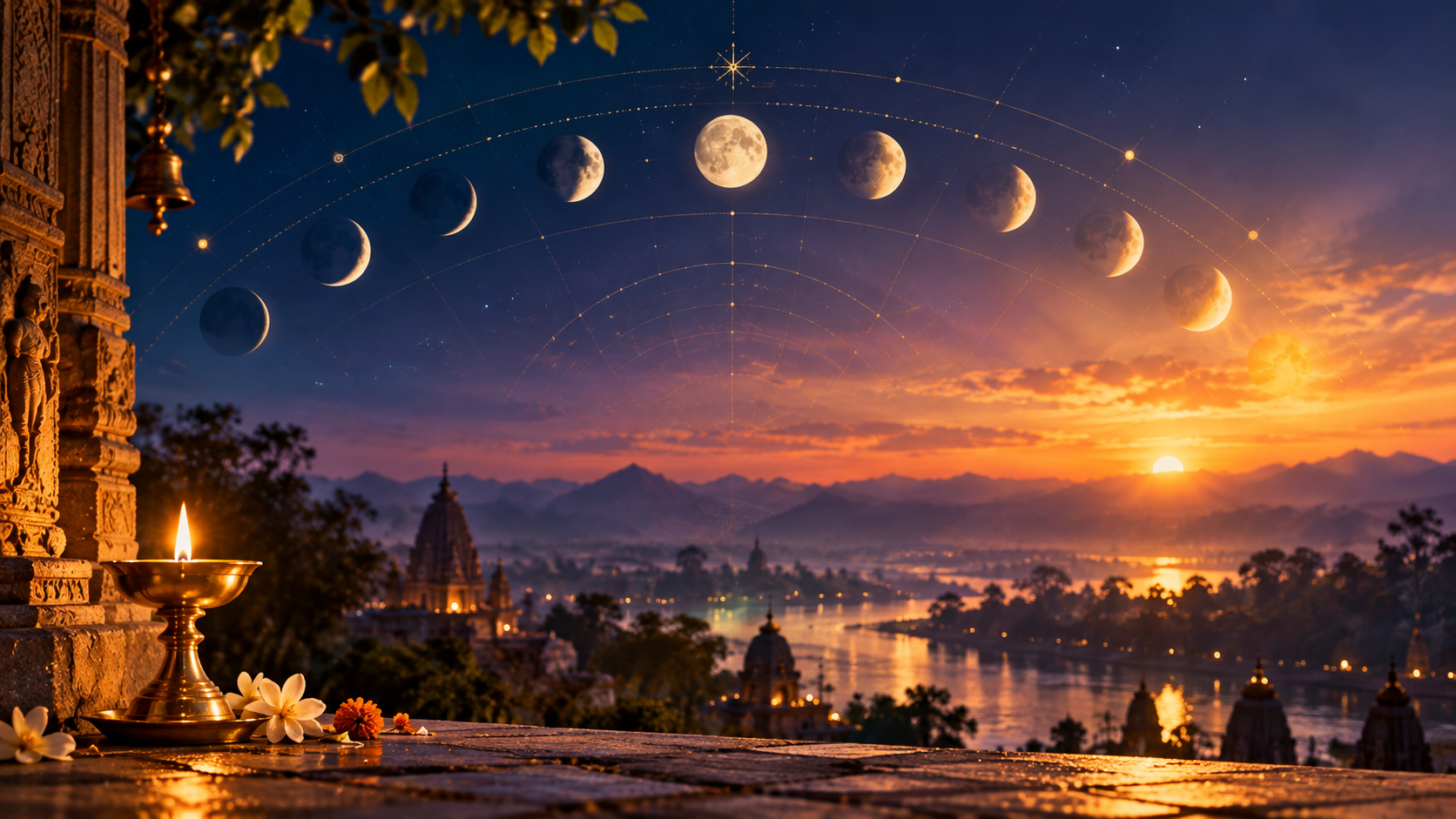
The Moon is eight days past full, waning, and rises near midnight: the hour the birth is kept, when the dark is deepest and the Moon is only just coming up.
Born at midnight, in a prison, to parents who could not keep him. The tradition puts its most joyful figure's birth in the least joyful place on purpose.
4 stories the day keeps. Turn each card.
Kamsa, king of Mathura, had locked his own sister Devaki and her husband Vasudeva in a prison. There, at midnight, Krishna was born. The tradition tells that the room filled with light, the guards fell asleep, and the chains loosened. Joy arrived in the least joyful place on purpose.
Bhagavata Purana 10.3.
Vasudeva lifted the newborn in a basket and walked out through the open gates into a night of rain. The Yamuna was in flood, yet it made way for him, and Shesha followed behind, spreading his hoods over the child to keep the rain off. A father carried his son across the river to safety.
Bhagavata Purana 10.3.
In Gokul, across the river, Yashoda had just given birth to a daughter while everyone slept. Vasudeva laid Krishna beside Yashoda, lifted the baby girl, and walked back to the prison before dawn. When Kamsa came for her, she rose out of his hands into the sky as the Goddess and told him the one he feared was already safe.
Bhagavata Purana 10.3 and 10.4.
In the morning Gokul woke to find that Nanda and Yashoda had a son. The cowherds came running with milk, curd and butter, splashed each other with them and sang through the village. The day after Janmashtami is still kept as Nandotsava, the festival of a whole village becoming a family.
Bhagavata Purana 10.5.
3 days kept as one season. Each has its own page.
A thread tied on the full Moon; protection promised, nothing asked back.
15 August 2095Midnight in the prison; the child carried across the Yamuna.
You are hereNandotsava
The morning after: Gokul wakes to find Nanda has a son.
Often said
If the fast is broken before midnight, the day is spoiled.
The root
Many keep a fast until the birth, and it is a beautiful discipline for those who can. But the Gita says yoga is not for the one who eats too much, nor for the one who does not eat at all (Gita 6.16). The child, the elder and the unwell eat, and their night of song is whole.
Free acts, done by you. Kept so far this year: 0 of 3.
Stay awake past midnight if you can, and sing or say Krishna's name at the hour of the birth.
Feed children who are not yours: sweets for the children of a building, a meal for a child who will not have one.
Read the birth aloud, the prison and the river crossing, so that a child in the house hears it from you.
Each act is free and done by you. Keeping one writes it to your karma ledger with the day's panchang. Nothing here is ever bought, and no act is a remedy.
The youngest
Decorates the cradle for the infant Krishna, and draws small footprints from the door to the shrine so he can walk in.
The eldest
Tells the story of the birth: the chains falling away, and Vasudeva carrying the child through the rain.
Everyone
At midnight, everyone rocks the cradle in turn and sings together.
Mathura and Vrindavan
The temples keep vigil through the night; at midnight the image of the infant is bathed in milk, curd and honey, and the cradle is rocked to song.
Maharashtra
Dahi Handi on the day after: young people build human pyramids to reach a pot of curd hung high, as the boy Krishna and his friends did for butter.
Tamil Nadu
Gokulashtami or Krishna Jayanthi: small footprints in rice flour lead from the doorway to the shrine, and the offerings are the snacks a child loves.
Gujarat
At Dwarka, the city Krishna built by the sea, the birth is kept at midnight with song and lamps, and homes across Gujarat rock the cradle with him.
Kept on the day its tithi runs at midnight (nishita).
The day is chosen by the moment the tradition reads its tithi at, and the times are that day's own, computed for this city. A festival-specific puja window is not printed: those rules differ by tradition and await a scholar's review.
The stories, their sources and the regional customs on this page await a scholar's review. The sky and the dates are computed for your city.